Learn more about the project and Development Plan update. Explore themes from the existing Development Plan and understand the issues and opportunities facing ‘Ewa’s future.
Want to get involved with the project or review project documents and resources?
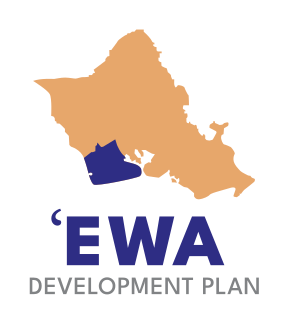
The ‘Ewa Development Plan area occupies the south western region of O‘ahu. It encompasses the coral plain which stretches from the northeastern end of Kunia Road down to Waipahu and Pearl Harbor, and around the southwestern corner of O‘ahu along the shoreline up to Nānākuli where the coral plain meets the moderately steep slopes of the southerly end of the Wai‘anae Mountain Range, which form ‘Ewa’s mauka sector.
The current ‘Ewa Development Plan was last updated in 2013, with an amendment in 2020, adopted by Ordinance 20-46. The plan established ‘Ewa as O’ahu’s “Second City”. Since then, ‘Ewa has experienced major shifts in housing demand, transportation needs and economic conditions. Updating the plan now ensures that growth, infrastructure, and services keep pace with community needs. The Plan update is an opportunity to:
ʻEwa has experienced some of the fastest population growth on Oʻahu over the past few decades, transitioning from a historically agricultural region into a major residential area. Large-scale housing developments in areas have driven rapid urbanization, increasing demand for infrastructure, transportation, schools, and public services.
Climate, Health, and Resilience
The ʻEwa region faces increasing environmental and public health pressures related to climate change, including rising temperatures, coastal flooding risk, and infrastructure vulnerability. Planning efforts emphasize strengthening community resilience through improved land use planning, protection of natural systems, and coordination of infrastructure, transportation, and emergency preparedness to support long-term community health and safety.
Agricultural land, Preservation, and Ecological Systems
The ʻEwa region contains significant agricultural lands that historically supported plantation-era sugar production. Preservation priorities focus on protecting remaining open spaces, cultural landscapes, and historic resources while guiding growth away from sensitive areas. Ecological systems require careful management to maintain biodiversity, support watershed health, and strengthen long-term environmental resilience.
Mobility, Walkability, and Connectivity
ʻEwa’s mobility challenges center on limited roadway connectivity, heavy reliance on a few major corridors and growing congestion as development continues. Improving walkability and multimodal connectivity is a key priority to reduce car dependence and improve access to schools, parks, jobs, and services. Strengthening local street networks and creating more connected neighborhood pathways can help make everyday travel safer and more convenient for residents.
Industrial Transition and Emerging Economy
ʻEwa is undergoing a gradual industrial transition toward a more diversified economic base. The area is seeing growth in logistics, renewable energy, technology-related uses, and mixed employment districts. This shift reflects an emerging economy in ʻEwa that combines modern industry, innovation, and service-sector employment.
Housing, Equity, and Livability
Housing, equity, and livability in the ʻEwa area generally focus on addressing rapid population growth while ensuring residents have access to affordable housing, essential services, and quality community amenities. Key issues include housing affordability, infrastructure capacity, equitable access to parks, schools, and healthcare, and creating complete neighborhoods that support daily needs close to home.
Cultural and Historic Preservation
The Development Plan update emphasizes balancing growth with the protection of ʻEwa’s cultural identity and historically significant places. ʻEwa contains several culturally and historically significant resources, including Native Hawaiian cultural sites, traditional agricultural landscapes, and historic features tied to plantation-era development and World War II military history.
Project Timeline
Read the project timeline in a text format
2025–2026 Phase: Initiation and Existing Conditions
Engagement Activities
Engagement Strategy
Branding, Factsheet, Project Website
Neighborhood Profiles
2026 Phase: Growth Framework
Engagement Activities
Community Symposium
Focus Groups
Online Survey
Pop-Ups
Open House
2027 Phase: Draft Development Plan
Engagement Activities
Focus Groups
Online Survey
Pop-Ups
2028-2029 Phase: Updated Development Plan
Engagement Activity
Planning Commission/City Council Adoption Processes
Community engagement and coordination with DPP, agencies, stakeholders, and the Community Advisory Committee throughout the Development Plan update.
Frequently Asked Questions (FAQ)
What is a development plan
The ʻEwa Development Plan is a long-range plan adopted by the City and County of Honolulu to guide growth and development in the ʻEwa region of Oʻahu. It establishes a vision, policies, and implementation actions related to land use, housing, transportation, infrastructure, environmental protection, and community facilities. The plan helps coordinate public investments and private development so that future growth in ʻEwa occurs in an organized, sustainable, and community-supported manner.
What limits does this plan have?
A Development Plan guides the long-term vision and policy direction for regional growth but does not regulate specific parcel-level details. Binding regulations, such as zoning, height limits, and development standards, are established through the Land Use Ordinance and related tools, which are periodically updated based on the Plan and formal review processes.
How can I get more involved in the planning process?
You can get involved by getting in touch with the project team to find out the latest update, participate in the upcoming engagement activities, review engagement materials and provide your inputs to the project team via email at ewadp@honolulu.gov. The ‘Ewa Development Plan process will include multiple opportunities for the community to provide feedback and share ideas that will help shape the plan.
Who is the County working with to update this plan?
The City and County of Honolulu Department of Planning and Permitting is responsible for regularly updating the Plan, in accordance with Section 6-1509, Revised Charter. The Plan will be adopted by an ordinance and can be found in Chapter 24, Revised Ordinances of Honolulu (ROH). DPP is working with the consultant, whom provide the consulting service throughout the project update cycle.
Join the Project Mailing List
Enter your information below to be added to the project mailing list and be notified of future project updates.
By providing your email and clicking “Submit” on this form you consent to receiving emails from the Department of Planning and Permitting of the City and County of Honolulu.